
Generative AI is the biggest technology shift legal has seen in years.
And yet, corporate adoption is still far from universal, with Wolters Kluwer’s 2025 report finding that 40% of legal departments don’t use any AI tools at all.
This hesitation makes sense, given that these legal teams are dealing with confidential data, shifting rules, and zero tolerance for error. A tool that can cite a case that doesn’t exist—with total confidence—doesn’t fit that picture.
However, even with all the risks of this technology, the case for AI in corporate law is stronger than the case against it.
To clarify the upside, this guide breaks down where AI is already proving useful in corporate law, and which benefits legal teams can expect when they put it to work.
AI in corporate law: 8 main use cases
AI can change more than how corporate lawyers complete individual tasks. Used across the legal department, it can reshape how teams manage transactions, compliance, outside counsel, and the growing volume of information that comes with running a company.
Here are eight areas where AI is already finding a practical role in corporate legal work.
1. Analyzing M&A targets and transaction risks
M&A due diligence means working through huge volumes of contracts and corporate records while looking for the few provisions that could materially change the deal. AI can help by:
- Extracting key deal terms: AI tools can identify change-of-control provisions, assignment restrictions, indemnities, and other transaction-sensitive clauses across large document sets.
- Flagging potential liabilities: The technology can surface outstanding obligations, intellectual property issues, governance problems, and other red flags that warrant closer review.
- Assessing transaction risks: AI can analyze patterns across the target’s underlying data to help counsel identify and evaluate risks that could affect the transaction.
- Checking regulatory exposure: AI systems can compare transaction details against applicable requirements and flag potential compliance or antitrust issues across jurisdictions.
This use case has long ceased to be just theoretical.
Back in 2016, Deloitte partnered with Kira Systems to automate parts of M&A diligence, using machine learning to extract and analyze contract clauses. The company trained Kira to identify thousands of data points and used the technology across hundreds of client projects, including some involving more than 100,000 documents. According to Deloitte, those projects delivered 20–90% time savings.
2. Managing corporate contracts
Corporate legal teams may be responsible for thousands of agreements, each containing different terms, obligations, renewal dates, and risk points. Reviewing this volume manually makes it difficult to consistently spot deviations, compare language across agreements, or keep track of important contractual data.
AI can take on several of these tasks, including:
- Extracting key terms: AI can pull provisions like renewal dates, payment terms, obligations, and other critical data from large contract portfolios.
- Comparing clauses: Machine learning tools can compare provisions against standard templates or previous agreements, highlighting deviations and non-standard language.
- Flagging inconsistencies: AI can scan contracts for unusual clauses and inconsistencies that may warrant closer legal review.
- Benchmarking positions: By analyzing historical agreements, AI can identify the most likely median end position for a particular clause and contract type, which is a useful context during negotiations.
- Managing obligations: AI can track contractual obligations across large portfolios, helping legal teams monitor what needs attention and when.
Contract review automation is undoubtedly one of the more established applications of AI in corporate law.
For example, JPMorgan developed its proprietary COiN platform to review commercial loan agreements. The software reviews documents in seconds—work that previously required approximately 360,000 hours annually from lawyers and loan officers—and helped reduce errors associated with interpreting roughly 12,000 new contracts each year.
Read more: Legal Contract Requirements: 8 Clauses for Businesses
3. Tracking regulatory change across jurisdictions
For multinational companies, regulatory compliance is a moving target. Legal teams may need to monitor new laws, amendments, enforcement changes, and guidance across multiple jurisdictions, then figure out which changes actually affect the business.
AI can continuously monitor regulatory developments, flag changes relevant to the company, and help compare requirements across jurisdictions. It can also support regulatory gap analysis by comparing different areas of legislation and assessing where existing policies may fall short.
Gusto offers a practical example.
Its legal team uses AI to monitor thousands of rules across employment law, benefits, and corporate compliance, with the system generating rule-change summaries and routing them to the appropriate lawyers.
4. Evaluating outside counsel performance and spend
Managing outside counsel gets complicated fast. Legal departments may be juggling dozens of firms, matters, invoices, billing arrangements, and performance data, but much of that information sits in separate systems and is difficult to analyze consistently.
That’s why nearly two-thirds of surveyed legal departments in Thomson Reuters report, “Ready or Not: Artificial Intelligence and Corporate Legal Departments,” said they have access to outside counsel and legal cost data, but only 49% said they were using that data effectively.
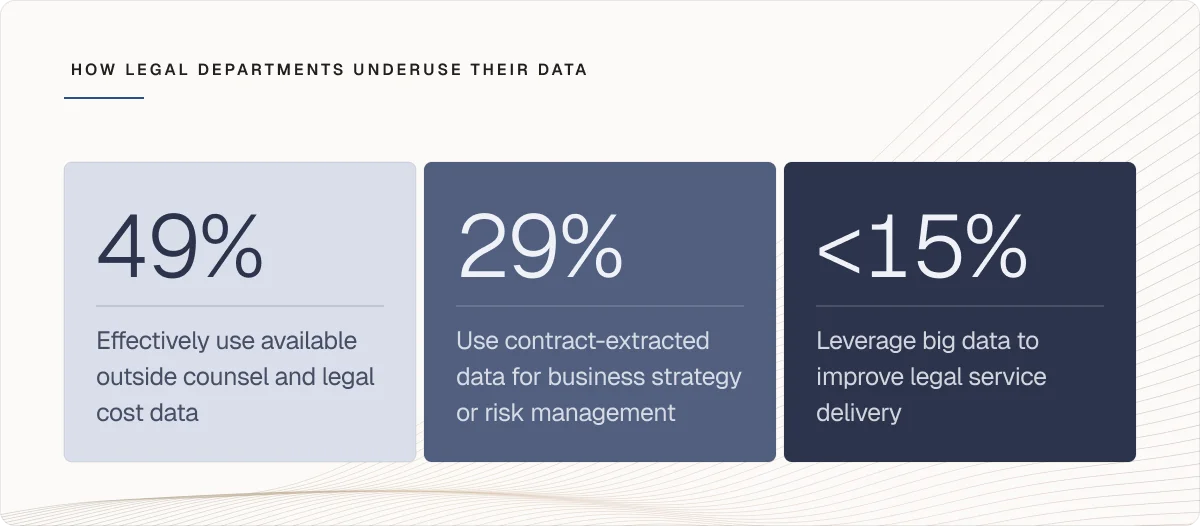
AI changes this equation by:
- Reviewing invoices: Duplicate charges, billing discrepancies, and fees outside agreed billing guidelines can be flagged automatically.
- Comparing firm performance: Legal teams can use historical matter data to assess firms across cost, outcomes, and efficiency.
- Analyzing legal spend: Spending patterns by firm or matter can reveal where costs are rising and where closer scrutiny may be warranted.
- Evaluating feedback: Internal feedback can be analyzed to surface recurring strengths, weaknesses, and performance issues across outside counsel.
- Matching firms to matters: Expertise, past performance, and cost data can be combined to identify firms suited to specific matters.
- Monitoring matter delivery: Deadlines and deliverables across outside counsel matters can be tracked, with reminders or escalations triggered when issues arise.
5. Forecasting litigation risk and exposure
Litigation is one of the harder areas for a legal department to forecast. The outcome can depend on the judge, jurisdiction, opposing counsel, case history, and dozens of other variables, making it difficult to assess exposure from the facts of a single matter alone.
AI can analyze historical case data to identify patterns that may inform these assessments.
Predictive tools like Lex Machina and Premonition can forecast litigation outcomes, estimate how long cases may take, and surface historical performance data on law firms appearing before particular judges.
For corporate legal teams, this analysis can feed into early case assessment, helping evaluate potential outcomes and exposure before deciding whether to settle, litigate, or adjust the broader strategy.
6. Orchestrating legal workflows and matter intake
Legal teams often have a messy front door. Requests come through email, Slack, forms, and business stakeholders, then need to be triaged, assigned, tracked, and routed to the right people.
AI can bring more structure to that process by:
- Classifying incoming matters: AI can analyze new requests, identify the type of legal issue involved, and route matters to the appropriate lawyer or workflow.
- Prioritizing requests: Legal teams can use factors such as urgency, risk, business impact, and deadlines to determine which matters need attention first.
- Automating intake questions: AI can gather the basic facts and documents needed to assess a request before it reaches counsel, reducing back-and-forth with the business.
- Routing work: Based on the matter type, jurisdiction, subject matter, or other predefined criteria, workflows can direct requests to the right internal team or outside counsel.
- Tracking matter progress: AI-driven workflows can monitor deadlines, handoffs, and outstanding actions so matters don’t disappear into an inbox.
7. Building searchable corporate legal knowledge bases
Corporate legal teams sit on years of institutional knowledge: past agreements, policies, legal guidance, matter records, and regulatory analysis. The problem is rarely whether the information exists; it’s finding the right piece of it when someone actually needs it.
Thanks to AI, these scattered resources can become a searchable knowledge base that lawyers and business teams can query in plain language.
In addition, AI can help with:
- Generating briefings: AI can synthesize existing legal knowledge into concise updates for lawyers and business teams.
- Creating training materials: Existing knowledge can be turned into training content for lawyers and employees without starting from scratch.
- Interrogating past work: Legal teams can query historical agreements, guidance, and matter records to find relevant positions and precedents when handling new work.
8. Mapping legal trends and emerging business risks
Corporate legal teams need to look beyond the matters on their desks. Changes in regulation, litigation patterns, contracts, and business activity can point to risks before they become active legal problems.
AI makes it possible to analyze these signals across much larger datasets and identify patterns that are difficult to spot manually.
Legal teams can use the technology for:
- Analyzing legal trends: AI can identify patterns across litigation, regulatory developments, contracts, and other legal data to show where issues are emerging.
- Identifying risk patterns: By analyzing large volumes of internal and external data, AI can surface recurring issues that may indicate developing legal or business risks.
- Supporting risk assessments: Legal analytics can combine historical data and current developments to give counsel a broader view when evaluating potential exposures.
- Informing business strategy: Trend analysis can give legal teams data-backed context for advising the business on emerging issues, rather than reacting only after a problem lands on their desk.
These applications are only part of the picture. For corporate legal teams, the real value comes from what those applications enable.
Why use AI in corporate law: 6 practical benefits for legal teams
Corporate legal leaders are increasingly expected to control spending, manage risk, support the business, and show that the department is contributing to broader company goals.
AI addresses several of those pressures at once by:
- Increasing efficiency: AI can automate routine, labor-intensive work and shorten tasks that once took hours or days, allowing legal teams to handle more matters without expanding resources at the same rate.
- Reducing costs: Shorter handling times and greater automation can reduce the work sent to outside counsel and the billable hours tied to routine legal tasks, making cost control one of the most direct financial benefits of AI adoption.
- Improving accuracy and quality: Pattern recognition and automated checks can help identify missed clauses, inconsistencies, and other errors across high-volume legal work, while automated document generation can also create greater consistency in contracts and policies.
- Strengthening risk management: Continuous analysis of contracts, legal obligations, regulatory developments, and historical case data gives corporate teams more ways to identify potential exposure and assess risks before they become larger legal problems.
- Supporting strategic decision-making: AI can turn legal data into actionable intelligence, helping teams analyze litigation trends, evaluate past strategies, and give the business more informed guidance on legal and operational decisions.
- Freeing lawyers for higher-value work: By taking routine analysis, document work, data processing, and other repetitive tasks off lawyers’ plates, AI gives in-house teams more capacity for judgment-heavy work and closer collaboration with the business. This matters as legal departments face pressure to demonstrate strategic value rather than operate purely as a back-office function.
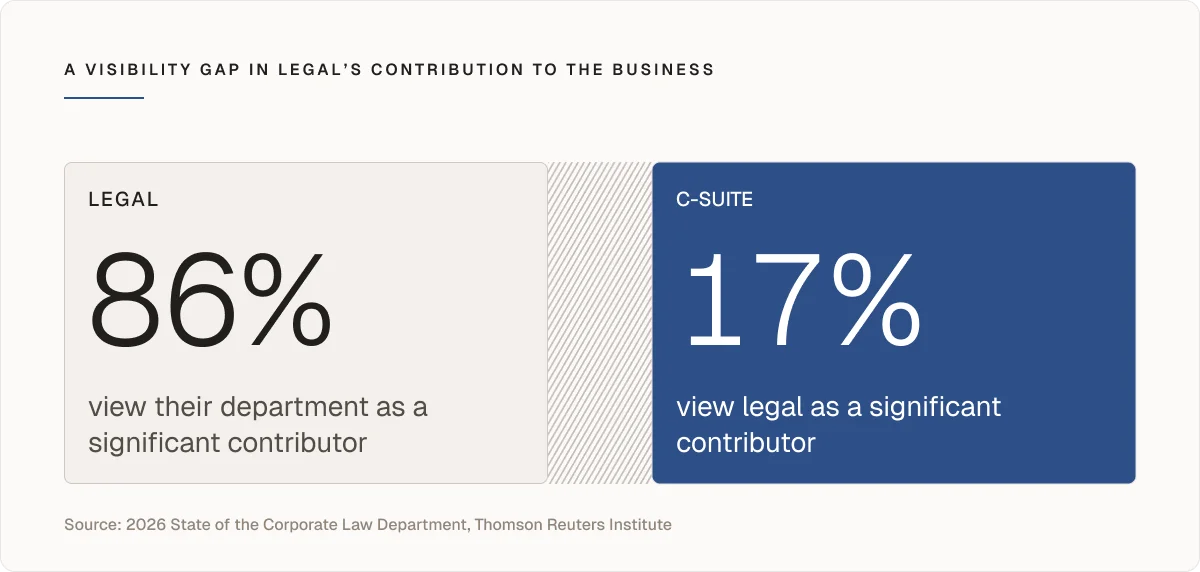
Even with all these benefits, it’s understandable why some corporate legal teams remain hesitant.
Relying on third-party AI tools can raise concerns around confidentiality, data security, accuracy, and control, while building proprietary systems requires significant investment in technology, training, governance, and ongoing maintenance.
So, where does that leave companies that want the benefits of AI without taking on all of the risks and infrastructure themselves?
Why work with AI-native law firms
Rather than forcing companies to choose between traditional outside counsel and building an AI legal operation in-house, AI-native law firms like General Legal combine legal expertise with AI-driven workflows and infrastructure.
For corporate legal teams, the practical difference starts with speed. General Legal turns standard commercial contracts around in hours rather than days or weeks.
Pricing is predictable, too. Most standard commercial contract reviews are handled for a flat fee rather than an open-ended hourly bill, so legal teams know what a matter will cost before the work starts.
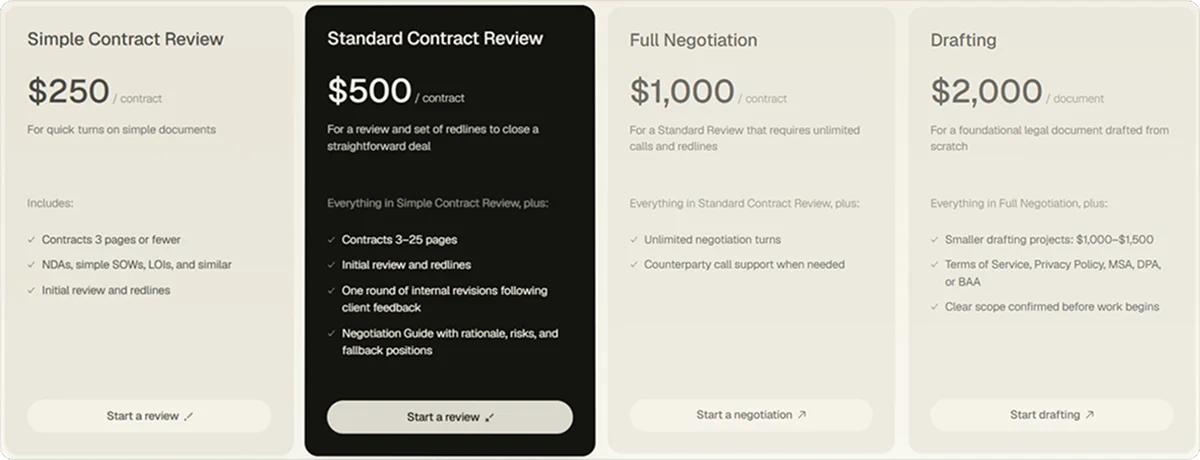
Then, there’s access to experienced lawyers without the traditional law-firm friction. Clients work directly with their attorney through Slack or a dedicated portal, instead of managing long email chains and repeated follow-ups just to get a matter moving.
And most importantly, the AI doesn’t replace the lawyer.
It handles the initial document analysis, issue spotting, and redlining, while a US-barred attorney reviews the work, applies legal judgment, and stands behind the final advice.
For companies with recurring commercial work, this combination becomes even more useful.
General Legal supports high-volume agreement review, so legal teams can send standardized contract work through the same workflow without treating every agreement like a bespoke law-firm engagement.
The result is straightforward: high-quality legal work, delivered faster, with more transparent pricing and less operational overhead.
To get started, you can book a 10-minute call with the General Legal team to discuss your legal needs and where we can help eliminate bottlenecks. Or, if you already have a contract that needs attention, send it to our team and get started directly; there are no upfront fees or commitments.
- Forty percent of legal departments still don't use any AI tools, despite the technology's proven ability to reduce costs and increase efficiency across corporate legal functions.
- AI applications in corporate law now span M&A due diligence, contract management, regulatory monitoring, outside counsel evaluation, litigation forecasting, workflow automation, knowledge management, and trend analysis.
- JPMorgan's COiN platform reduced commercial loan agreement review from 360,000 annual hours to seconds, while Deloitte reported 20–90% time savings on M&A diligence projects using AI.
- AI-native law firms combine legal expertise with AI-driven workflows to deliver faster turnaround times, flat-fee pricing, and direct attorney access without replacing human legal judgment.
- The primary benefits of AI in corporate law include cost reduction, improved accuracy, enhanced risk management, better strategic decision-making, and freeing lawyers for higher-value work.
- Corporate legal teams can adopt AI without building in-house systems by partnering with AI-native firms that handle the technology infrastructure while maintaining attorney oversight.
| Current AI adoption | 40% of legal departments use no AI tools, citing confidentiality concerns and zero tolerance for error despite proven benefits. |
|---|---|
| M&A and due diligence | AI extracts deal terms, flags liabilities, and assesses transaction risks; Deloitte achieved 20–90% time savings on projects with 100,000+ documents. |
| Contract management | AI extracts terms, compares clauses, flags inconsistencies, and tracks obligations across thousands of agreements; JPMorgan saved 360,000 annual hours reviewing loan contracts. |
| Regulatory compliance | AI monitors regulatory changes across jurisdictions and routes relevant updates to appropriate lawyers, as demonstrated by Gusto's employment law monitoring. |
| Outside counsel management | AI reviews invoices for discrepancies, compares firm performance, analyzes spend patterns, and matches firms to matters based on expertise and cost. |
| Litigation forecasting | Predictive tools analyze historical case data to forecast outcomes, estimate duration, and surface law firm performance before particular judges. |
| Core benefits | AI reduces costs, improves accuracy, strengthens risk management, supports strategic decisions, and frees lawyers for judgment-heavy work. |
| AI-native law firms | Firms like General Legal deliver contract reviews in hours with flat-fee pricing and direct attorney access, combining AI efficiency with human legal oversight. |
What is the 30% rule for AI?
The 30% AI rule is an informal guideline suggesting that AI should handle roughly 30% of a task while humans retain the remaining 70% for judgment, oversight, and decision-making.
Has a lawyer ever used AI?
Yes. Lawyers already use AI for legal research, document review, drafting, e-discovery, and other work.
Can AI act as a lawyer?
No. AI can’t independently provide legal services as a lawyer. In the US, legal advice and representation remain subject to rules governing the practice of law, and lawyers remain responsible for supervising AI and verifying its output.
How many law firms use AI?
A growing majority of law firms now use AI in some form, with adoption spanning large firms, specialized practices, solo attorneys, and smaller firms. In some cases, adoption reaches 100%, with Bloomberg Law’s 2026 Leading Law Firms survey finding that all 40 participating firms with more than 500 attorneys used legal-specific AI tools in 2025.
Will corporate lawyers get replaced by AI?
No. AI is more likely to change what corporate lawyers do than eliminate the profession. Routine work like document review and research is increasingly automated, while legal judgment, strategy, counseling, and accountability still require lawyers.
- Legal Contract Requirements: 8 Clauses for BusinessesExplore legal contract requirements so you can understand what makes agreements enforceable, identify key clauses, & protect your business from risks.
- 12 Types of Commercial Law You Should Know in 2026Explore the types of commercial law so you can understand your legal needs, manage business risks, and choose the right legal support.
- Contract Review Automation: Top Benefits & Use CasesA deep dive into how General Legal automates contract review