
How many shares a startup company should authorize at incorporation is one of the few formation decisions that follow you into your first VC round. If you get it wrong, you can hit the ceiling between rounds, when a key hire's option grant or a new co-founder's shares suddenly require stockholder consent and a state filing before anyone can sign.
10 million shares is the standard for most technology startups, and this article explains why that number works (and when it doesn't).
Carta's 2024 data on time between VC rounds puts the median interval from seed to Series A at approximately 2.1 years. Over that stretch, your authorized count has to absorb new hires and early SAFEs, and possibly a bridge round, before a priced close happens.
The complication is that the number goes into your certificate of incorporation before you know how many people you'll hire, how many SAFEs you'll sign, or what your lead investor will ask for. Most formation services fill it in with a default and move on.
This guide explains how authorized shares work, why the standard number isn't always the right number, and what to get right before you file.
What are authorized shares?
Authorized shares are the maximum number of shares your corporation is legally permitted to issue, as set in your certificate of incorporation. The company doesn't have to issue all of them, and at formation, it almost certainly won't.
Unissued shares are reserved capacity: The portion of the authorized pool the company draws on for option grants, SAFE conversions, and bridge notes without filing a charter amendment each time.
But authorized is only one of three share counts on your cap table, and confusing the other two is where most errors start.
How do authorized, issued, and outstanding shares differ?
These three terms measure the same equity structure from different vantage points, and mixing them up leads to real cap table errors.
At a typical two-founder pre-seed formation, the 10 million shares are split across three buckets:
- Founders: 8,000,000 shares (80%), issued at formation
- Option pool (reserved): 1,500,000 shares (15%), reserved for employees
- Unallocated reserve: 500,000 shares (5%), held back for future issuances
Unallocated shares carry no ownership until the board formally issues them, which is what makes the reserve worth having.
Why do most startups authorize 10 million shares at incorporation?
Ten million works because it solves four problems at once:
- Granularity for founder splits: Authorizing 100 shares handles the split itself but leaves nothing usable for employees, since a 0.5% grant would be half a share.
- Room for an option pool: Most early-stage companies set aside 10–20% of fully diluted shares for employee equity. At 10 million shares, a 15% pool is 1,500,000 shares, large enough to make individual grants competitive.
- SAFE and note headroom: Instruments that convert at the priced round need room alongside the new preferred and the refreshed pool, and a count that's too tight before the round makes that math harder to negotiate.
- Investor expectations: Experienced VC investors expect a share count that signals a properly structured Delaware C-corp. Very low numbers (100) or extremely high ones (1 billion) invite scrutiny, whereas 10 million is unremarkable in the best way.
Some founders authorize 12,000,000 or 15,000,000 upfront when they anticipate heavy early hiring or multiple SAFE rounds before a priced close.
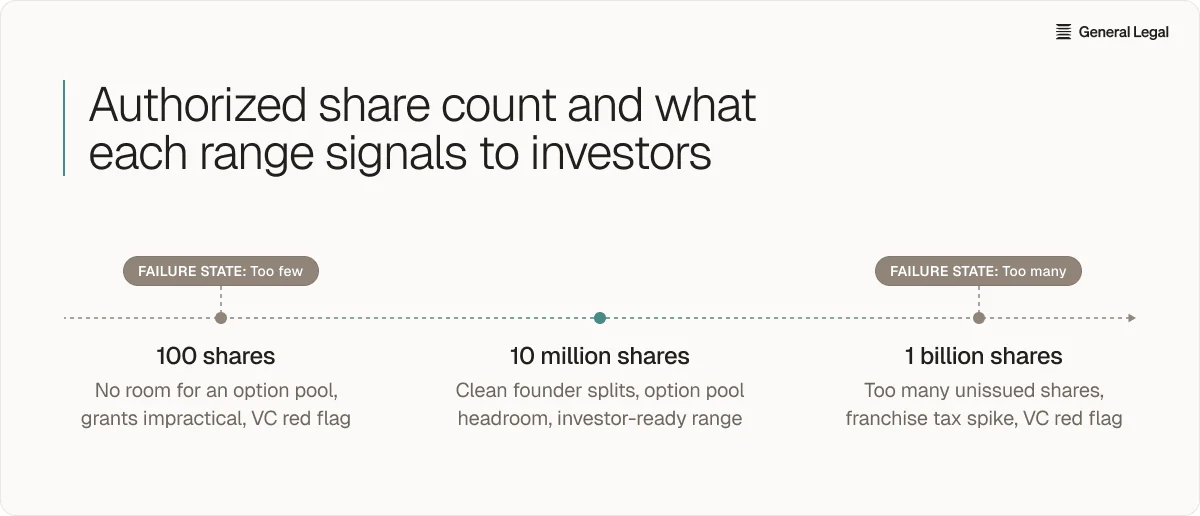
The number you choose also comes with a cost, and it shows up every March with your franchise tax notice.
Read more: How to Form a Company Your AI Agent Can Run Legally in 2026
How does your authorized share count affect Delaware franchise tax?
Your authorized share count directly determines your Delaware franchise tax bill. Delaware offers two calculation methods and lets you pay whichever is lower, though it defaults to the more expensive one unless you actively request the alternative.
The authorized shares method charges based purely on how many shares you've authorized, per the Delaware Division of Corporations:
- 5,000 shares or fewer: $175
- 5,001–10,000 shares: $250
- Above 10,000: $250 base, plus $85 for each additional 10,000 (or fraction)
At 10,000,000 shares, that produces a bill of $85,165.
The assumed par value capital method calculates tax based on your total gross assets and the ratio of issued shares to authorized shares, at a rate of $400 per $1,000,000 of assumed par value capital (minimum $400). For a pre-revenue company with few assets, this method typically produces a bill of $400–500.
Most early-stage startups pay far less under the assumed par value capital method, but you have to request it by entering your issued shares and total gross assets when filing your annual report. If your notice shows tens of thousands of dollars and your gross assets are small, Delaware has applied the authorized shares method, and entering your financial data when you file will trigger the recalculation.
Franchise tax is only one input, though, and the right number for your company depends on several other decisions you'll make at formation.
Pro tip: The assumed par value capital method uses your total gross assets as of December 31, the figure from your federal return (Form 1120, Schedule L), so keep a balance sheet from day one even if the numbers are small.
Read more: How Much Does it Cost to Incorporate a Startup?
5 factors that determine how many shares to authorize
The 10 million default covers most situations, but the right number depends on several decisions being made at the same time.
1. The number of founders and your equity split
Founder count matters less for rounding than for headroom. Every share issued to founders at formation is one fewer available for the pool and future conversions, so four founders taking 9,000,000 shares leave far less room than two founders taking 8,000,000.
2. Your option pool target
A 10–20% pool is standard at pre-seed, and the authorized share count needs to be large enough to support it. Expanding the pool later means amending your equity incentive plan, which needs board approval and, in most cases, stockholder approval, particularly if you want new options to qualify as ISOs.
At a priced round, investors typically require the option pool to be refreshed pre-money, which means it comes out of the founders' stake before new money is counted. The pool you size at formation is the baseline. If the expansion would push you past the authorized ceiling, a charter amendment comes first.
3. Outstanding SAFEs and convertible notes
SAFEs and notes don't appear on your cap table as shares until a priced round triggers conversion.
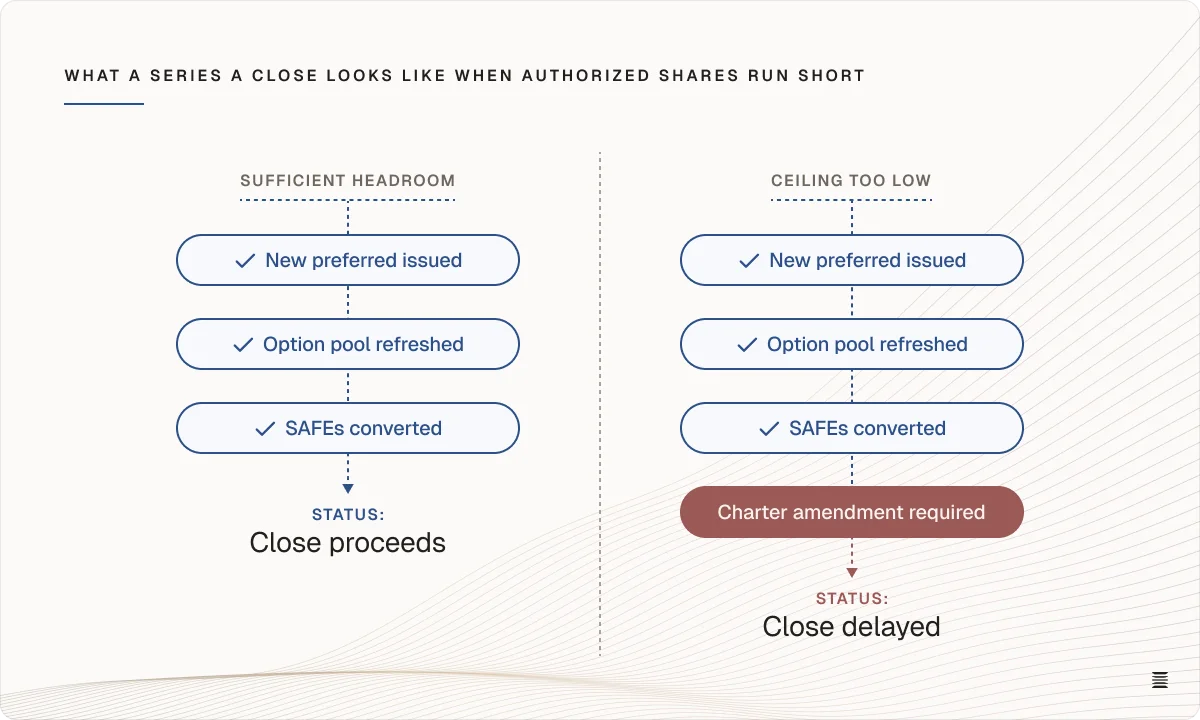
An authorized count that can't fit the converted instruments, the refreshed pool, and the incoming preferred simultaneously requires a charter amendment before the round can close. The cleaner the count before the term sheet arrives, the less of the negotiation gets spent on cap table math.
4. Your par value
Most Delaware startups set par value at $0.00001 per share (one-thousandth of a cent). Par value is the legal floor below which shares can't be issued. Keeping par low lets founders buy their shares for a nominal amount at formation, which keeps the 83(b) election simple.
Shares bought at formation also start the clock on QSBS under IRC Section 1202, which for stock issued after July 4, 2025 can exclude up to $15 million (or 10 times basis) of gain, with partial exclusions available after three and four years.
5. The cost of amending later vs. authorizing more now
The Delaware state filing fee for a certificate of amendment is $214 per the Delaware Division of Corporations fee schedule (the fee varies if the amendment changes authorized shares or par value), plus attorney time to prepare the board and stockholder consents. Between rounds, that's manageable, but when investors are waiting on a condition precedent, it can hold up a deal that was already moving.
Authorizing enough shares to reach your first priced round without amendment costs little or nothing at formation, as long as par value is low and you file franchise tax under the assumed par value capital method.
Read more: When to Involve a Law Firm in Startup Fundraising
What happens if you authorize too few shares?
Under-authorizing is a more common problem than over-authorizing, and it stays invisible until the first term sheet lands. A Series A itself usually isn't where it hurts, because the round closes with an amended and restated charter that resets the count anyway.
The problem shows up earlier, when a key hire's option grant, a new co-founder's shares, or a bridge SAFE runs into a reserve that's already tapped out. Fixing it then means a board resolution, stockholder consent, a certificate filed with the Delaware Secretary of State, on whatever timeline the hire or investor is waiting on.
None of these steps is complex in isolation, but together they add process to a moment that was supposed to be straightforward.
The problem is that most founders choose between two imperfect options at formation. An online formation service files in minutes but fills in the share count, par value, and pool with defaults nobody checks against your hiring plan, while a traditional firm reviews all of it on the billable hour.
For an early-stage company, the better route sits between the two.
General Legal: Getting your authorized share structure right from day one
General Legal is an AI-native law firm that handles incorporations for startups through its Emerging Companies and Venture Capital practice. AI takes care of intake and document preparation, while attorneys work through the decisions that determine the decisions that shape the certificate and the equity plan behind it:
- Authorized share count: Sized for the hires, SAFEs, and investor rounds that follow formation, not just Day 1
- Par value: Set to support the 83(b) election and QSBS qualification from the start
- Option pool: Sized to reach the first priced round without a charter amendment
The output is a certificate reviewed by a lawyer before it's filed, at a flat fee quoted upfront.
Create a free account and send us your formation questions directly, or book a 10-minute working session with our team before you file.
- 10 million authorized shares is the standard for Delaware C-corps because it provides sufficient granularity for founder splits, employee option pools, and SAFE conversions without requiring charter amendments between rounds.
- Authorized shares set a legal ceiling but don't dilute ownership until the board actually issues them—authorization and issuance are separate legal events.
- Delaware franchise tax bills vary dramatically based on calculation method: the authorized shares method costs $85,165 at 10 million shares, while the assumed par value capital method typically costs $400–500 for early-stage companies.
- Under-authorizing shares creates problems between formation and Series A when key hires, new co-founders, or bridge SAFEs exhaust the reserve and trigger mid-fundraise charter amendments.
- The right share count depends on founder splits, option pool targets, outstanding SAFEs, par value decisions, and hiring plans—not just the formation service default.
- Setting par value at $0.00001 per share keeps 83(b) elections simple and starts the QSBS clock for potential capital gains exclusions of up to $15 million under IRC Section 1202.
| Standard authorization | 10 million shares is the default for most Delaware C-corps, providing headroom for founders, options, and early conversions without charter amendments. |
|---|---|
| Three share counts | Authorized (legal ceiling), issued (distributed by company), and outstanding (held by shareholders) are distinct measurements with different legal meanings. |
| Delaware franchise tax | Tax calculation defaults to the expensive authorized shares method ($85,165 at 10M shares) unless you request the assumed par value capital method ($400–500 for early-stage companies). |
| Customization factors | Founder count, option pool size, outstanding SAFEs, par value, and hiring plans all determine whether 10 million is the right number for your company. |
| Under-authorization risk | Authorizing too few shares forces charter amendments between rounds when option grants or SAFE conversions exceed capacity, adding process at critical moments. |
| Par value strategy | Setting par at $0.00001 per share simplifies 83(b) elections and starts the QSBS qualification clock for potential capital gains tax exclusions. |
| Amendment cost | Charter amendments cost $214 in Delaware filing fees plus attorney time, making it cheaper to authorize correctly at formation than fix mid-fundraise. |
| Preferred shares timing | Most startups authorize only common stock at incorporation and create preferred shares later through an amended and restated certificate at the first priced round. |
Should I authorize preferred shares at incorporation?
Most startups authorize only common stock at incorporation. Preferred shares are created later, when a priced round closes, through an amended and restated certificate that defines the new class and its rights.
Does authorizing more shares dilute existing shareholders?
No. Authorizing shares and issuing them are two separate legal events. Ownership percentages only shift when the board formally issues shares to someone new, and the size of the authorized pool on its own changes nothing.
What happens to the authorized share count at a Series A?
It goes up. The company files an amended and restated certificate of incorporation as part of closing, which sets a new authorized total large enough to cover the new preferred shares, the refreshed option pool, and anything converting from SAFEs or notes.
Can I use a formation service instead of a lawyer?
A formation service can work for a straightforward two-founder company. Formation services fall short on the judgment calls specific to your situation (founder count, outstanding SAFEs, hiring plans before a priced round), and getting those wrong creates cleanup work at the worst possible time.
Does Delaware require a minimum number of authorized shares?
Delaware doesn't require a minimum number of authorized shares, but a very low count makes meaningful grants impractical.
- 6 Best Law Firms for Growing Startups To Choose in 2026 [Comparison]An overview of the top law firms for growing companies.
- The Startup Advisor Contract: What to Include & What to AvoidLearn what you need to know about the startup advisor contract so you can define equity, protect your business, and avoid costly legal mistakes.
- 5 Best Company Formation Companies for Startups [Comparison]Explore the best company formation companies so you can compare your options, choose the right provider & build your business.