
Law firms using AI are quickly becoming the norm, with adoption reaching levels that took cloud computing nearly a decade to achieve in just a few years.
Clio’s Legal Trends Report puts AI usage among legal professionals at 79% in 2024, up from 19% in 2023—a fourfold increase in a single year. Other surveys put adoption even higher, reaching 92% among practicing lawyers worldwide.
But how do these numbers translate to established law firms?
This guide moves past the general trend lines to look at specific firms, breaking down how they’re using generative AI, which tools they’re building or adopting, and how deeply the technology is being integrated into their practices.
Which law firms are using AI in 2026?
Nearly every type of law firm is now using AI, from global BigLaw firms and specialized practices to solo attorneys and small firms.
What’s more, the adoption reaches as high as 100%, with Bloomberg Law’s 2026 Leading Law Firms survey finding that all 40 participating firms with over 500 attorneys used legal-specific AI tools in 2025. These staggering figures make sense once you look at the many benefits of AI in law.
Legal teams use AI to cut hours of document review, accelerate legal research, and take repetitive drafting work off lawyers’ plates. However, there are still differences in how law firms approach the technology.
Broadly, law firms using AI fall into three categories:
- Firm adopting third-party AI tools: These firms integrate commercial AI platforms into existing legal workflows to improve legal workflows.
- Firms building proprietary AI tools: These firms are developing custom applications around their own workflows, precedents, and institutional knowledge.
- AI-native law firms: A smaller group of firms is building their legal practice around AI from the ground up, rather than adding it to an existing operating model.
These models aren’t mutually exclusive. Many established firms take a hybrid approach, combining commercial AI platforms with proprietary systems.
Law firms using third-party AI tools
Third-party AI adoption is the most straightforward way to deploy AI. Rather than developing its own AI systems, the firm adopts existing platforms built for legal research, drafting, document review, due diligence, and other common workflows.
This approach is particularly useful for firms that want to capture the productivity benefits of AI without overhauling their existing technology infrastructure or organizational structure. Commercial platforms can be integrated into established workflows, allowing lawyers to start using AI without the firm having to build and maintain the underlying technology.
When it comes to AI tools themselves, law firms can choose from general-purpose AI assistants, enterprise productivity tools, legal-specific platforms, and specialized tools for tasks like contract review. Popular examples include:
- Harvey
- Thomson Reuters CoCounsel
- Lexis+ AI
- Microsoft Copilot
- Spellbook
- Luminance
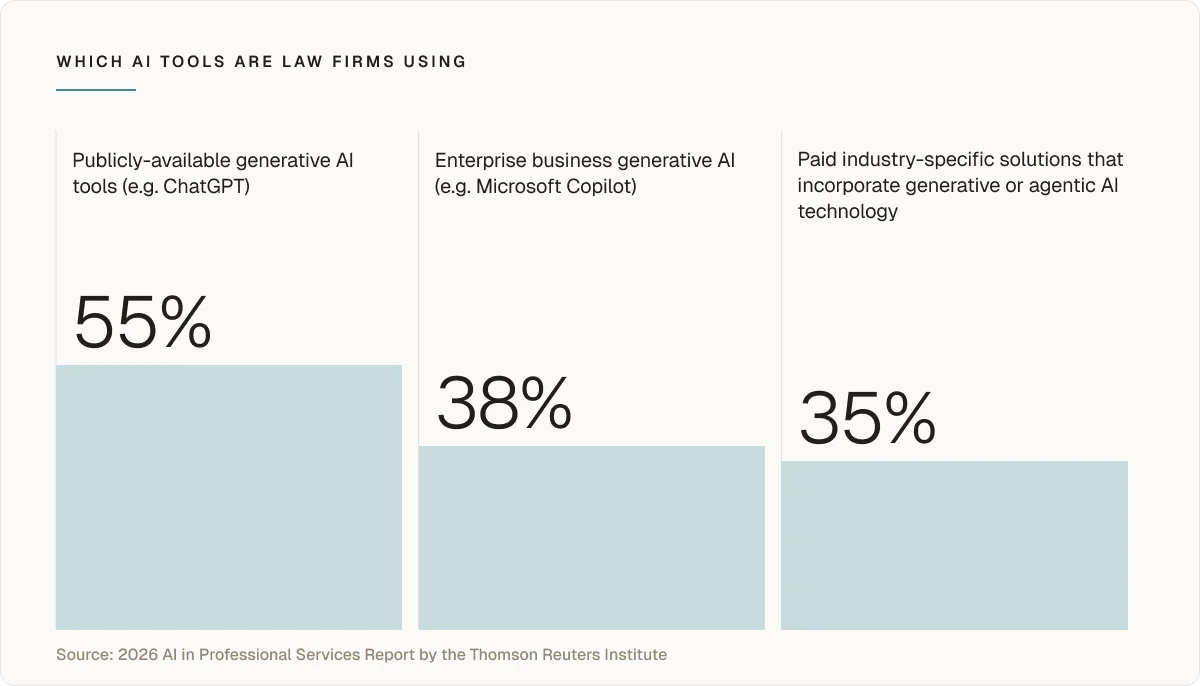
The range of options means firms can adopt AI incrementally, starting with specific workflows and expanding their use as lawyers become more comfortable with the technology.
The tradeoff is that firms remain dependent on external platforms and have less control over how the technology is customized to their specific workflows and institutional knowledge. This makes third-party adoption a natural entry point for AI, but not necessarily the end state.
A list of notable law firms using AI tools
- A&O Shearman deployed Harvey firmwide for contract analysis, multilingual drafting, and regulatory horizon-scanning.
- Orrick is an early adopter of CoCounsel, integrating the platform into litigation and transactional work and using agentic workflows for high-volume document analysis.
- Paul Weiss uses Harvey’s Workflow Builder to create custom AI workflows based on the firm’s own methodologies and best practices.
- Jackson Lewis deployed Harvey to more than 1,100 attorneys across over 60 offices and is working with Harvey’s Legal Engineering team to develop applications tailored to labor and employment workflows and matter management.
- Foley & Lardner relies on a broad mix of commercial platforms, including Harvey, Microsoft Copilot, CoCounsel, Draftwise, Relativity aiR, and Patlytics, alongside its own FoleyChat workspace. The firm describes its approach as “AI-first, not AI-only,” with AI supporting contract review, diligence, research, drafting, litigation, and patent work.
- Latham & Watkins is a hybrid example, using commercial tools including ChatGPT, Claude, and Gemini while also investing in Nvidia-powered infrastructure for running and customizing models internally. Its firmwide AI Academy provides training on AI tools, ethics, disclosure, and best practices.
This hybrid approach is becoming more common as firms seek greater control over how AI fits into their work, leading them to invest in technology tailored to their needs.
Law firms building their own AI tools
Some law firms are building proprietary systems of their own, designing them around their existing legal knowledge, precedents, negotiating playbooks, workflows, and institutional expertise.
The main appeal here is control.
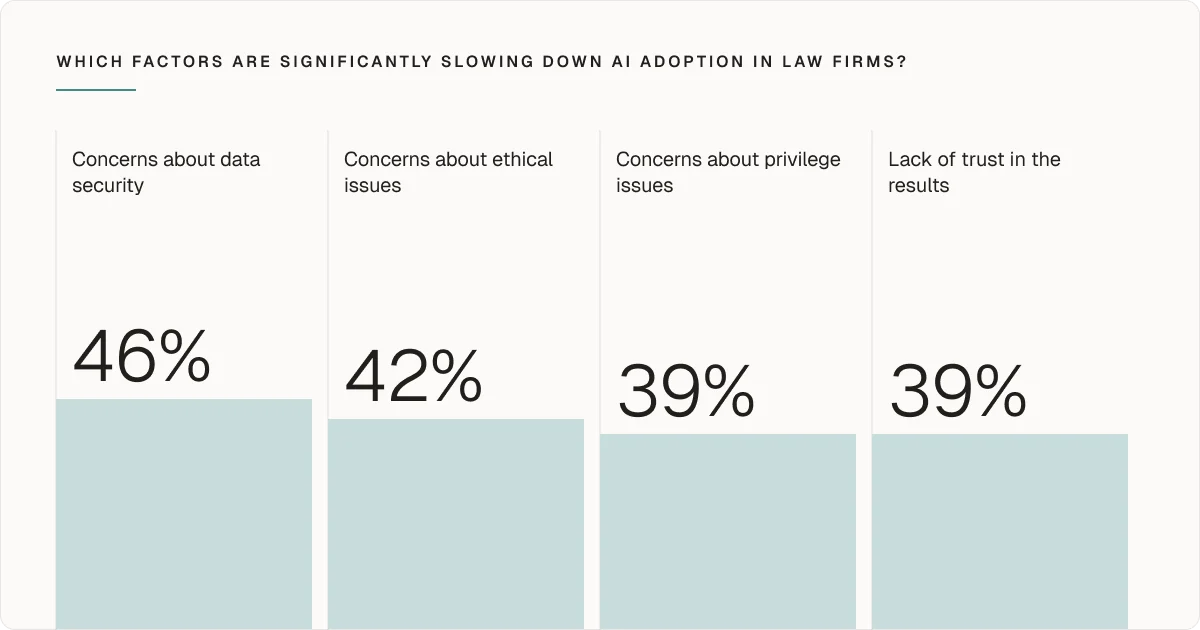
A proprietary system can be tailored to how a firm actually works, turning years of accumulated legal knowledge into repeatable, AI-assisted workflows. It can also give firms greater control over how they handle sensitive information, which matters given that 46% of firms identified data security as a significant barrier to AI adoption in 8am’s 2026 Legal Industry Report.
However, building proprietary AI comes with a much higher level of investment and responsibility.
Firms need the technical talent, data infrastructure, governance processes, and ongoing resources to build, test, secure, and maintain these systems. They also take on more of the risk when a custom system produces an error or fails to perform as expected.
A list of notable law firms building proprietary AI tools
- Cooley built Cooley AI, including Cooley GO Public, which uses purpose-built AI agents to assist with IPO and S-1 preparation. The system combines client information, public sources, and Cooley’s curated precedents, with legal engineers, innovation counsel, and practitioners working together to translate the firm’s capital markets expertise into a proprietary AI system.
- Sullivan & Cromwell developed Agreement Analyzer, a custom application built with the firm’s precedents and negotiating playbooks. It analyzes agreements, identifies issues, and supports negotiations, with broader deployment across the firm in development.
- Ropes & Gray worked on a proprietary AI diligence-review tool with OpenAI that turns large transaction data rooms into detailed, issue-level diligence reports. This example shows that “proprietary” doesn’t necessarily mean built entirely in-house; the firm can build a custom system in collaboration with an external AI provider.
- Wilson Sonsini Goodrich & Rosati built Neuron with Dioptra, embedding the firm’s legal knowledge into proprietary workflows for contract review. The firm has also used the technology to support fixed-fee commercial contracting, making it an example of AI serving both as an operational tool and as part of a client-facing legal service.
- Goodwin launched Regina OS, an internal AI platform designed to provide reusable infrastructure across the firm rather than a collection of isolated applications.
- Willkie Farr & Gallagher developed Wendell Intelligence, its proprietary AI platform, while also integrating LexisNexis Protégé, Harvey, AI workflow agents, and other purpose-built systems.
- Morgan & Morgan rolled out MX2, a proprietary AI platform used by roughly 5,000 people monthly for medical-record extraction, case-document generation, research, and trial preparation. The firm says it has invested approximately $300 million in technology and AI, demonstrating that significant proprietary AI investment extends beyond traditional BigLaw.
Many firms are also announcing major investments in proprietary AI infrastructure.
One notable example is Kirkland & Ellis, which committed $500 million over three to four years to developing its own AI technology, supported by a team of engineers, data scientists, and lawyers.
However, much of this investment is still focused on making existing law firms more efficient, while clients are increasingly asking what those efficiency gains mean for the way legal services are delivered and priced.
That’s where AI-native law firms enter the picture.
AI-native law firms
In AI-native law firms, AI isn’t simply another tool for lawyers to use; it’s part of how the firm structures its workflows, staffing, service delivery, and, in many cases, pricing.
This distinction matters for clients.
Traditional firms can invest heavily in AI while keeping the same underlying model of legal work. AI-native firms, by contrast, are built to capture AI’s benefits from the outset, particularly for predictable and repeatable work that can support more efficient delivery and fixed or hybrid pricing.
This means that clients don’t have to wait for established firms to gradually redesign their operations. AI-native firms are already built around these efficiencies, while human lawyers remain focused on strategy, negotiation, advocacy, and other judgment-heavy work.
A list of AI-native law firms
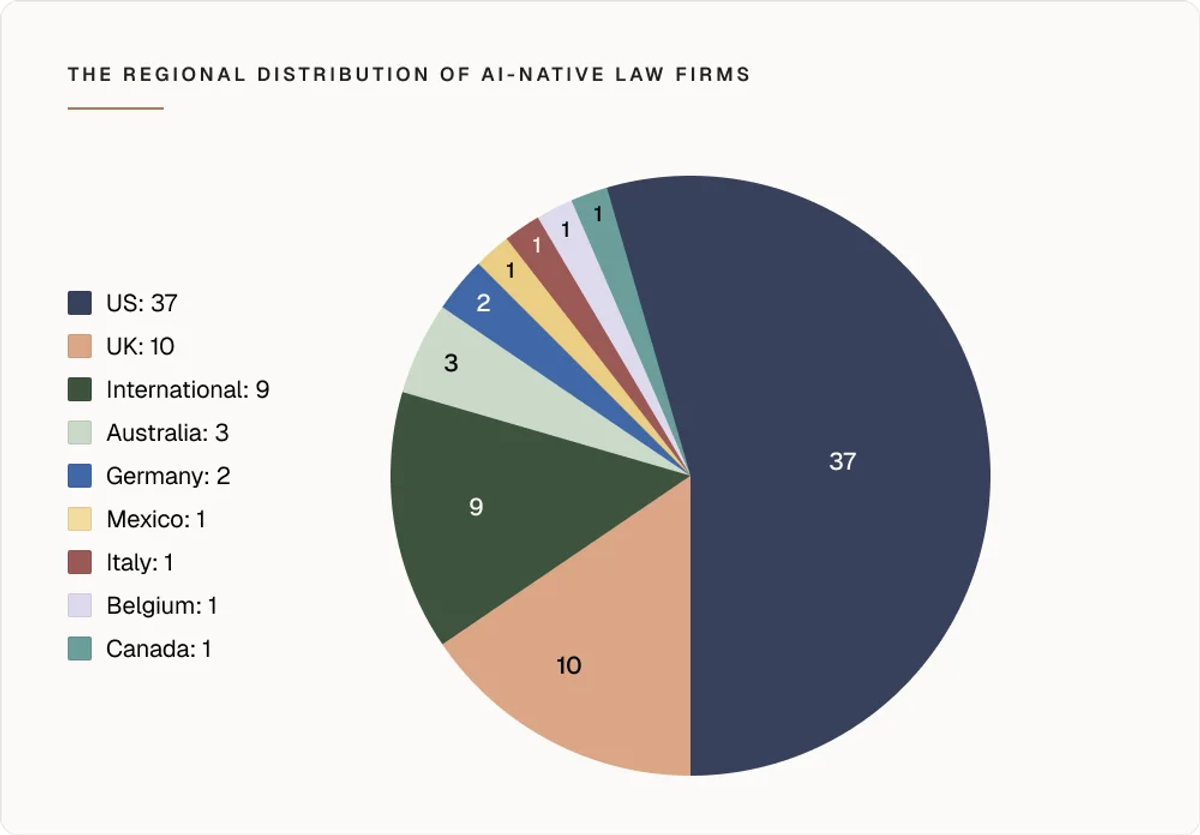
As of late September 2026, there are just 65 AI-native law firms worldwide, according to the AI Firm Index, making it possible to provide a complete list rather than a selection.
The firms are distributed across the US, UK, Australia, Germany, and other markets, with the US accounting for 57% of the total.
Although the category is still small, it’s already attracting serious backing. Some AI-native law firms have even been accepted into Y Combinator, including LegalOS, Vector Legal, and General Legal.
Why work with General Legal
General Legal is built around a simple idea: If AI makes lawyers more efficient, clients should be the ones who benefit from that efficiency.
This guiding principle shows up in the way the firm actually operates.
General Legal combines highly qualified, US-barred attorneys with AI-powered workflows that handle the repetitive and analytical parts of contract work, while lawyers remain responsible for judgment, strategy, and the final legal advice. Its contract AI, Sentinel, takes the first pass through a document, surfacing issues and preparing redlines before an attorney reviews the full contract and the AI’s work.
The result is a materially different client experience.
Standard commercial contracts can be turned around in hours rather than days or weeks, with flat-fee pricing instead of open-ended billable hours.
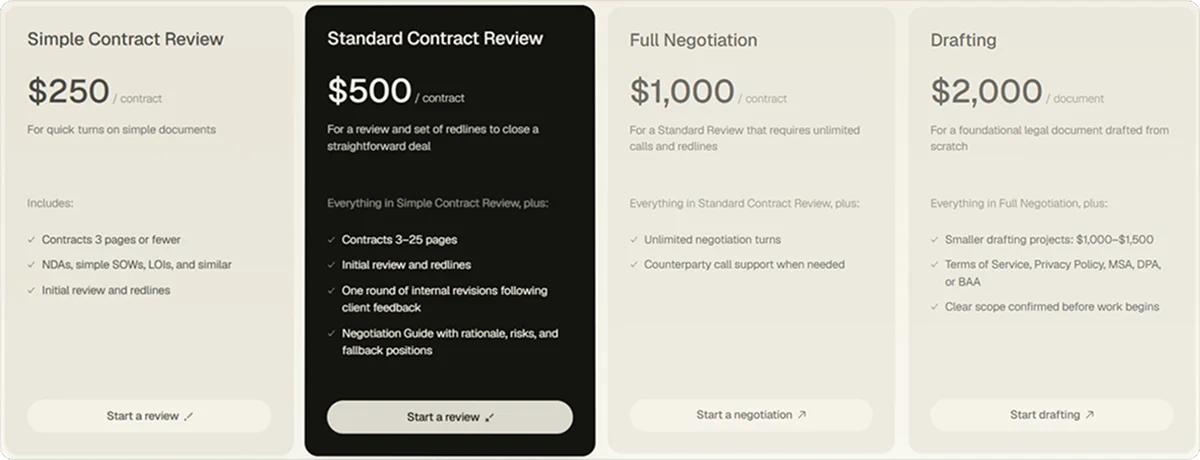
Clients can work directly with their attorney through Slack, while automation handles many administrative handoffs that slow traditional law firm workflows. Most importantly, this ease of access doesn’t come at the expense of legal coverage.
General Legal handles everything from technology transactions and employment agreements to data privacy, financial regulatory work, blockchain matters, tax work, and emerging-company and VC work.
If you have a matter in one of these areas, you can get started online and begin working with our team without a lengthy onboarding process. Alternatively, if you want to discuss your needs first, you can schedule a short introductory call to see where General Legal can help.
- AI adoption among law firms jumped from 19% in 2023 to 79% in 2024, with 100% of firms over 500 attorneys now using legal-specific AI tools.
- Law firms approach AI through three models: adopting third-party platforms like Harvey and CoCounsel, building proprietary systems tailored to their workflows, or operating as AI-native firms from the ground up.
- Major firms like Kirkland & Ellis have committed $500 million to proprietary AI development, while others like A&O Shearman and Orrick integrate commercial platforms firmwide.
- AI-native law firms, though numbering just 65 worldwide as of September 2026, are built around AI-powered workflows that enable faster turnaround times and fixed-fee pricing instead of billable hours.
- The shift to AI allows firms to automate document review, legal research, and drafting, freeing lawyers to focus on strategy, negotiation, and judgment-heavy work.
- Data security remains a significant concern, with 46% of firms identifying it as a barrier to AI adoption despite widespread implementation.
| Adoption rates | AI usage among legal professionals reached 79% in 2024, up from 19% in 2023, with 100% adoption among firms over 500 attorneys. |
|---|---|
| Third-party tools | Firms like A&O Shearman, Orrick, and Foley & Lardner integrate commercial platforms such as Harvey, CoCounsel, and Lexis+ AI into existing workflows. |
| Proprietary systems | Firms including Cooley, Sullivan & Cromwell, and Wilson Sonsini build custom AI tools using their own precedents and institutional knowledge. |
| Major investments | Kirkland & Ellis committed $500 million over 3-4 years to proprietary AI, while Morgan & Morgan invested approximately $300 million. |
| AI-native firms | Just 65 AI-native law firms exist globally as of September 2026, built around AI workflows to deliver faster service and fixed pricing. |
| Client benefits | AI-native firms like General Legal turn around commercial contracts in hours with flat fees, while human lawyers handle strategy and judgment. |
| Security concerns | 46% of firms cite data security as a significant barrier to AI adoption despite high implementation rates. |
| Use cases | AI automates document review, legal research, contract analysis, due diligence, and drafting across litigation, transactional, and regulatory work. |
Can a law firm use AI?
Yes. However, AI can’t replace a lawyer’s professional responsibility. The American Bar Association’s Formal Opinion 512 says lawyers using generative AI must still meet their duties of competence, confidentiality, communication, supervision, candor, and reasonable fees.
Which law firms use AI?
Law firms using AI include A&O Shearman, Latham & Watkins, Paul Weiss, Orrick, Wilson Sonsini, Goodwin, Willkie Farr & Gallagher, Kirkland & Ellis, Skadden, Cooley, Sullivan & Cromwell, Ropes & Gray, Foley & Lardner, and General Legal, among many others.
Which AI are law firms using?
Law firms are using tools including Microsoft Copilot, Harvey, Thomson Reuters CoCounsel, Claude, Lexis+ AI, ChatGPT Enterprise, and other legal-specific and general-purpose AI systems. More advanced firms are also deploying proprietary AI tools built around their own legal knowledge, workflows, and institutional expertise.
How do Latham and Watkins use AI?
Latham & Watkins use AI through tools including ChatGPT, Claude, and Gemini, alongside internally managed AI infrastructure and firmwide training through its AI Academy.
Could AI ever replace lawyers?
As of now, AI can’t replace lawyers. AI could automate an increasing share of legal work, particularly predictable and repetitive tasks, but current AI doesn’t replace the lawyer’s responsibility for judgment, strategy, ethics, client advice, and accountability.
- 9 Best Legal Tech Companies for Contract Solutions [Comparison]Discover the best legal tech companies for contract solutions so you can compare features, workflows, and services.
- 7 Leading Contract Automation Tools for Legal Teams in 2026Discover leading contract automation tools for legal teams so you can compare features, workflows & solutions that fit your needs.
- 6 Best Harvey Alternatives for Law Firms [2026 Comparison]Explore the best Harvey alternatives so you can compare legal AI tools by cost, features, workflows, and ease of adoption.